
Why High-Resolution Contact Scanners Fall Short for Newborn Fingerprinting
May 20, 2026
The logic behind contact scanners
Contact fingerprint scanning is the global standard for adult biometric identification. Decades of deployment, ISO and FBI certification, deep integration with ABIS systems worldwide. When programs began exploring infant identification, the natural first step was to adapt this proven technology: build the same type of scanner, but with higher resolution to capture the finer ridges of a baby's finger.
The logic is sound on paper. In practice, it runs into a problem that no amount of resolution can fix.
The deformation problem
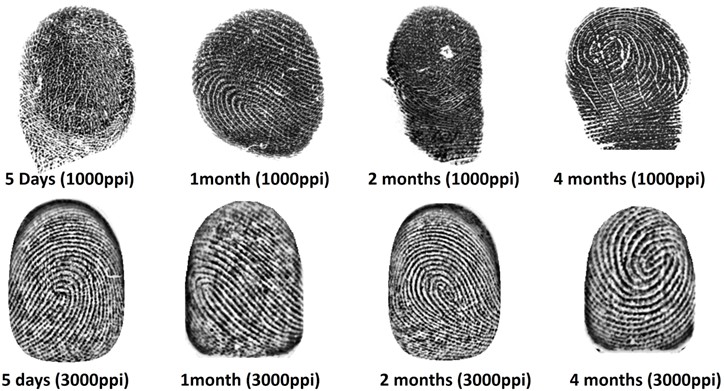
A newborn's skin is fundamentally different from an adult's. It is softer, more hydrated, more pliable. When an adult presses a finger against a glass platen, the skin conforms slightly but the ridge structure holds. When a newborn's finger touches the same surface, the skin deforms under even minimal pressure. Ridges merge with valleys. The fine detail that the scanner was engineered to capture is destroyed in the act of capturing it.
This happens before the scan begins. The sensor may operate at 1,000 ppi, 2,000 ppi, or even 5,000 ppi. The resolution is irrelevant because the physical fingerprint has already been distorted by the time the image is recorded. Increasing optical resolution to solve a mechanical problem is like adding more megapixels to a camera with a smudged lens.
Pushing resolution higher — and hitting the same wall
Some manufacturers have responded by pushing resolution to extreme levels — 5,000 ppi and above — combined with specialized optics and imaging techniques. For older children whose skin has begun to firm up, these systems can produce meaningful results. The improvement is real.
For newborns and very young infants, the core constraint remains. The skin is too soft. The contact still deforms it. The ridge structure is still distorted at the point of capture, regardless of how many pixels the sensor captures afterward.
AI to the rescue? Not so fast
Recognizing that contact deformation degrades the captured image, some systems add an AI preprocessing step. After capture, a neural network attempts to reconstruct the fingerprint — inferring what the ridges and minutiae should look like based on patterns learned from training data.
This approach produces visually impressive images. A blurred, distorted capture goes in; a clean, detailed fingerprint comes out. The problem lies in what that "clean" image actually represents.
When a neural network reconstructs information that was lost during capture, it draws on statistical patterns from its training data. It generates plausible-looking ridge structures, but those structures may not correspond to the actual fingerprint. The medical imaging literature has a formal term for this: hallucination. The model produces features that look real but were never present in the captured signal.
For a civil identity system, this creates a specific and serious risk. If hallucinated minutiae are injected into the biometric template stored in the national database, the corruption is permanent and undetectable. Months or years later, the same child may fail to match their own identity record — because the record contains features that were never on their finger. Or worse, the hallucinated features may generate false matches with other individuals in the database.
The chain of custody problem
Beyond hallucination, AI reconstruction breaks something fundamental: the chain of custody between the physical finger and the stored identity. In a system without AI preprocessing, the stored template is a direct representation of what the sensor captured. Auditors can trace the record back to the physical source. With AI reconstruction in the pipeline, the stored template represents the AI model's interpretation of a degraded input. The link between the physical finger and the stored identity passes through a black box.
For a national civil identity program — one that will need to match records across decades — this introduces a dependency that is difficult to audit, difficult to reproduce across different software versions, and difficult to explain when a match fails.
What the published evidence shows
Several groups working on high-resolution contact systems for infants have produced substantial operational datasets and peer-reviewed papers documenting their data collection methodology and image quality analysis in real-world deployments. This work is valuable.
However, verification and identification performance results — the metrics that tell you whether the system can actually match an infant's fingerprint reliably — have not yet been published for newborn populations. The core question remains open.
A different approach: remove contact entirely
The Synolo® Neo works differently. Instead of capturing through a glass platen and compensating for the damage afterward, the system photographs the fingerprint from above. The infant's finger is placed in a fixed aperture but never touches any surface. Contact deformation is eliminated at the source.
Purpose-built optics operating at 3,000+ ppi resolve the fine ridge detail of newborn fingers — detail that is preserved because the skin was never distorted. The processing pipeline normalizes infant ridge spacing and outputs templates compatible with standard national ABIS systems. No AI reconstruction sits between capture and template. What the sensor sees is what the system stores.
The clinical evidence supports this approach. A prospective trial published in Nature Scientific Reports followed 494 children from birth for up to 19 months, demonstrating reliable enrollment from the first days of life. Independent researchers at Clarkson University tested the system across 254 children from newborn to fifteen years, spanning the full identity lifecycle. These validations come from multiple countries, institutions, and research groups — including teams with no commercial relationship to Synolo®.
Building a system that lasts
A national infant identification program is a long-term commitment. The identity record created at birth will need to match the same person at health posts, civil registry offices, and border checkpoints years and decades later. A system built on AI compensation for capture-stage failures introduces dependencies that compound over time. Software models change. Training data evolves. The template stored today may not behave the same way under tomorrow's matching algorithm.
A system that captures the actual fingerprint — without deformation, without reconstruction — gives programs a foundation they can audit, reproduce, and trust across the long time horizons that civil identity demands.
See what non-contact capture can do
If you're evaluating fingerprint systems for infant identification, the choice between contact and non-contact capture is the most consequential technical decision you'll make. Synolo® can show you exactly how the Neo performs with newborn populations and how it integrates with your existing ABIS infrastructure. Get in touch to start the conversation.
Ready to innovate with infant biometrics?
Get in touch and discover how Synolo® Neo can transform civil identification.
Contact UsReferences
ENGELSMA, J. J.; DEB, D.; CAO, K. et al. Infant-ID: Fingerprints for Global Good. IEEE Transactions on Pattern Analysis and Machine Intelligence, v. 44, n. 7, p. 3543–3559, 2022. DOI: 10.1109/TPAMI.2021.3057634.
SAGGESE, S.; ZHAO, Y.; KALISKY, T. et al. Biometric recognition of newborns and infants by non-contact fingerprinting: lessons learned. Gates Open Research, v. 3, n. 1477, 2019. DOI: 10.12688/gatesopenres.12914.2.
JAIN, A. K.; ARORA, S. S.; CAO, K.; BEST-ROWDEN, L.; BHATNAGAR, A. Fingerprint Recognition of Young Children. IEEE Transactions on Information Forensics and Security, v. 12, n. 7, p. 1501–1514, 2017. DOI: 10.1109/TIFS.2016.2639346.
KALISKY, T.; SAGGESE, S.; ZHAO, Y. et al. Biometric recognition of newborns and young children for vaccinations and health care: a non-randomized prospective clinical trial. Scientific Reports, v. 12, n. 22520, 2022. DOI: 10.1038/s41598-022-25986-6.
SUMI, M. R.; IMTIAZ, M. H.; SCHUCKERS, S. A Longitudinal Study on Fingerprint Recognition in Infants, Toddlers, and Children. Preprints.org, 2024. DOI: 10.20944/preprints202405.0224.v1.
BHADRA, S.; KELKAR, V. A.; BROOKS, F. J.; ANASTASIO, M. A. On Hallucinations in Tomographic Image Reconstruction. IEEE Transactions on Medical Imaging, v. 40, n. 11, p. 3249–3260, 2021. DOI: 10.1109/TMI.2021.3077857.
ZHANG, X.; KELKAR, V. A.; GRANSTEDT, J.; LI, H.; ANASTASIO, M. A. Impact of deep learning-based image super-resolution on binary signal detection. Journal of Medical Imaging, v. 8, n. 6, 065501, 2021. DOI: 10.1117/1.JMI.8.6.065501.
RUZICKA, L.; SPENKE, A.; BERGMANN, S.; NOLDEN, G.; KOHN, B.; HEITZINGER, C. Towards Fingerprint Mosaicking Artifact Detection: A Self-Supervised Deep Learning Approach. arXiv preprint arXiv:2501.05034, 2025.
SOUTHIER, L. F. P.; FILIPAK, M.; ZANLORENSI, L. A. et al. An on-production high-resolution longitudinal neonatal fingerprint database in Brazil. arXiv preprint arXiv:2504.20104, 2025.
MACHADO, J. H. P.; KOOP, B. de O.; FILIPAK, M.; BARBOSA, M. A. C.; OLIVA, J. T.; SOUTHIER, L. F. P.; CASANOVA, D.; TEIXEIRA, M. A Super-Resolution Approach for Image Resizing of Infant Fingerprints With Vision Transformers. IEEE Access, v. 13, p. 67718–67728, 2025. DOI: 10.1109/ACCESS.2025.3561206.
SOUTHIER, L. F. P.; NUNES, G. A. T.; MACHADO, J. H. P. et al. A Systematic Literature Review on Neonatal Fingerprint Recognition. ACM Computing Surveys, v. 57, p. 1–34, 2025. DOI: 10.1145/3735551.
Topics
contact fingerprint scanner newborns · why contact scanners fail newborns · infant biometrics · newborn biometrics · baby biometrics · baby identification · newborn fingerprinting · newborn identification · infant identification · AI infant biometrics fingerprint reconstruction · newborn birth registration biometrics · civil identity · neonatal biometric registration · hospital newborn identification · maternity hospital newborn biometrics · birth to adulthood infant biometric matching · longitudinal fingerprint matching · Synolo Neo · non-contact fingerprint scanner · baby fingerprint scanner · 3000 PPI fingerprint scanner · FBI PIV certified · ABIS integration · glass platen fingerprint scanner · fingerprint deformation newborns · AI fingerprint hallucination · newborn biometric chain of custody · optical fingerprint scanner · high resolution fingerprint scanner
