
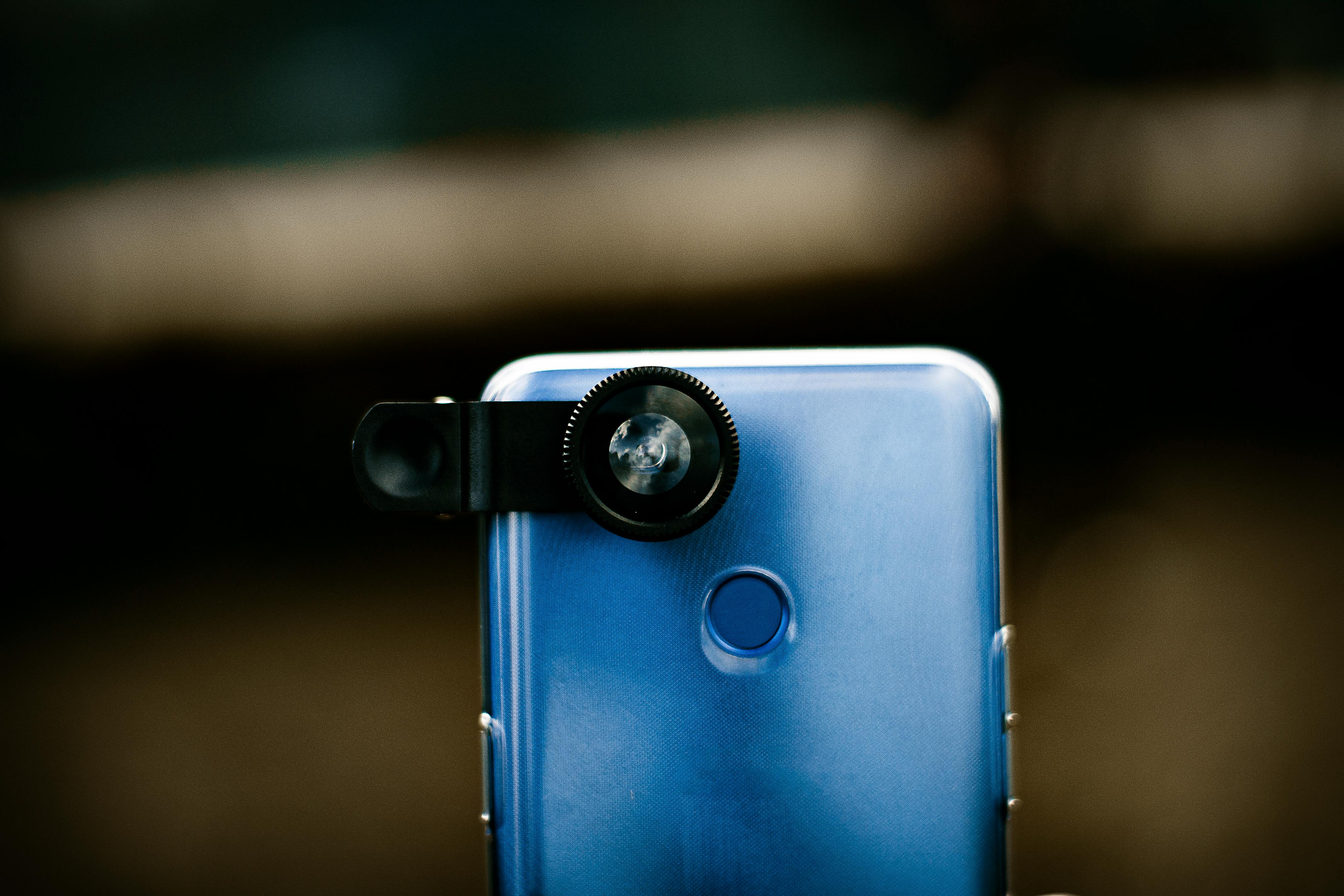
Why Smartphones Fail at Infant Biometrics and Identification
May 19, 2026
The appeal of smartphone-based capture
The pitch is compelling. Community health workers globally already carry smartphones. The devices cost a fraction of specialized hardware. Modern phone cameras have improved dramatically. If you could capture a newborn's biometrics with a phone — fingerprint, face, iris, all at once — you could scale infant identification without deploying new equipment.
For adult populations, this approach works. Smartphone-based identification has proven itself in field conditions for grown-ups. The question is whether it can do the same for newborns.
The published evidence says it cannot.
Fingerprints via phone camera: wrong tool for the job
Smartphone cameras can handle adult fingerprints reasonably well — but infant fingerprint ridges are up to 2.5 times finer, and that resolution gap is where phone cameras fall short. A newborn's fingerprint ridges require at minimum 2,000 ppi to capture meaningful detail. No smartphone camera reaches that resolution at the close focal distances needed for fingerprint capture.
Beyond resolution, the practical challenges stack up. Lighting varies from one room to the next. Focus is difficult to control at close range. The background introduces noise. Most workflows require two people — one to hold the infant's tiny finger steady and one to operate the phone — and even then, keeping the finger visible without obstructing it is difficult with an uncooperative baby.
The result is a low-resolution, inconsistently lit, variably focused image of a ridge structure that the sensor could not resolve in the first place.
Face recognition: a modality that ages out of usefulness
Newborn face recognition has been studied. The results are consistent: a baby's face changes so rapidly in the first months that a photo taken at birth will not reliably match the same child weeks later. Fat deposits shift. Bone structure develops. Proportions change. Published research confirms that recognition accuracy for infants under six months remains below operational thresholds for civil identification.
Automatic face detection adds another layer of failure. Newborns keep their eyes closed much of the time, and detection algorithms trained on adult faces struggle with infant facial geometry.
For a system that needs to match an identity from birth through childhood and beyond, face recognition at birth is a record with a built-in expiration date.
Iris capture: infants won't cooperate
Iris recognition requires the subject to hold their eyes open and look toward the camera. Newborns do neither on demand. Studies report that more than half of infants cannot be enrolled at all.
Even when a capture succeeds, the iris pattern itself is not yet stable. It does not reach the consistency needed for reliable matching until approximately the second year of life. A newborn iris capture is both difficult to obtain and unreliable once obtained.
Palm scan: compounding problems
Palmprint capture starts with an obstacle that has nothing to do with the phone. Newborns have a grasp reflex that keeps their fists tightly closed. Capturing a usable palm image requires an open, flat hand — something a newborn will not provide on demand. A second person is needed just to coax the hand open, and even then the hand rarely stays flat long enough for a clean shot.
Assuming that hurdle is cleared, the phone's imaging limitations take over. A palm is a large, curved surface. Smartphone cameras struggle to keep it in uniform focus, and the uncontrolled lighting typical in clinical settings casts shadows across the ridges. Holding the hand flat in the air introduces motion blur from the infant's movements.
The result is an image that is difficult to obtain, geometrically distorted, and rarely sharp enough to extract reliable minutiae — even before factoring in that standard ABIS systems are not optimized for neonatal palm ridge spacing.
Multimodal fusion: four failures don't make a success
Some smartphone-based systems attempt to address these individual limitations through multimodal fusion — combining face, iris, palm, and fingerprint signals with AI to produce a single identity decision. The logic is that even if each modality is weak, combining them might produce a strong result.
This reasoning has a flaw. When each modality fails for the same population — newborns — fusing them does not create information that was not captured. An infant whose fingerprint ridges are unresolvable, whose face will change within weeks, whose iris is unstable and uncooperative, and whose palm cannot be opened or imaged cleanly remains unidentifiable regardless of how many signals you combine.
Fusion works when individual modalities provide partial but genuine information. When each modality returns noise or unreliable data, the fusion produces a confident-looking answer built on an unreliable foundation.
AI enhancement: the same hallucination risk
Some smartphone-based systems apply AI image enhancement after capture — using neural networks to sharpen blurred fingerprint images or improve facial recognition quality. This AI preprocessing step carries the same risk documented in the medical imaging literature: when a model attempts to reconstruct detail that was never captured, it can hallucinate features that look plausible but do not correspond to the actual biometric.
For fingerprints, hallucinated minutiae injected into the stored template create permanent, undetectable corruption in the identity record. For a civil registration system that needs to work for decades, this is not an acceptable trade-off.
No clinical validation for newborns
Perhaps the most consequential gap: no published clinical study has tested smartphone-based multimodal capture at operational scale with newborn populations in real healthcare settings. The performance claims for this approach with infants remain unvalidated by independent, peer-reviewed research.
Programs evaluating smartphone-based options for infant biometrics are, at present, evaluating an unproven approach.
Purpose-built hardware exists for this problem
The Synolo® Neo was engineered specifically for infant fingerprinting. Instead of adapting a general-purpose device, it addresses the two core challenges — resolution and contact deformation — with purpose-built design.
The system captures fingerprints without contact. The infant's finger is placed in a fixed aperture but never touches a surface, eliminating the skin deformation that makes both smartphone and contact scanner captures unreliable. Purpose-built optics operating at 3,000+ ppi resolve newborn ridge detail that no smartphone camera can reach. The fixed aperture controls lighting, focus, and background — variables that smartphone capture leaves to chance.
No AI reconstruction sits between the captured image and the stored template. The processing pipeline normalizes infant ridge spacing and outputs templates compatible with standard national ABIS systems. The identity record represents the actual fingerprint.
Clinical validation backs this up. A prospective trial published in Nature Scientific Reports followed 494 children from birth for up to 19 months, confirming reliable enrollment and longitudinal matching. Independent researchers at Clarkson University tested the system across 254 children from newborn to fifteen years. These studies span multiple countries and institutions, including teams with no commercial relationship to Synolo®.
The right tool for the right job
Smartphones are useful for a lot of tasks. For adult biometrics in field conditions, they have proven their value. For newborn identification, the physics and physiology work against them. The resolution is insufficient, the modalities fail for infant populations, and AI enhancement introduces risks that civil identity programs cannot afford.
When the stakes are a child's lifelong identity, the tool needs to match the task. Synolo® built the Neo for exactly this purpose. Get in touch to see how it performs with newborns and how it integrates with your identification program.
Ready to innovate with infant biometrics?
Get in touch and discover how Synolo® Neo can transform civil identification.
Contact UsReferences
ENGELSMA, J. J.; DEB, D.; CAO, K. et al. Infant-ID: Fingerprints for Global Good. IEEE Transactions on Pattern Analysis and Machine Intelligence, v. 44, n. 7, p. 3543–3559, 2022. DOI: 10.1109/TPAMI.2021.3057634.
SAGGESE, S.; ZHAO, Y.; KALISKY, T. et al. Biometric recognition of newborns and infants by non-contact fingerprinting: lessons learned. Gates Open Research, v. 3, n. 1477, 2019. DOI: 10.12688/gatesopenres.12914.2.
JAIN, A. K.; ARORA, S. S.; CAO, K.; BEST-ROWDEN, L.; BHATNAGAR, A. Fingerprint Recognition of Young Children. IEEE Transactions on Information Forensics and Security, v. 12, n. 7, p. 1501–1514, 2017. DOI: 10.1109/TIFS.2016.2639346.
JAIN, A. K.; ROSS, A.; PRABHAKAR, S. An introduction to biometric recognition. IEEE Transactions on Circuits and Systems for Video Technology, v. 14, n. 1, p. 4–20, 2004.
CORBY, P. M. et al. Using biometrics for participant identification in a research study: a case report. Journal of the American Medical Informatics Association, v. 13, n. 2, p. 233–235, 2006.
BHARADWAJ, S.; BHATT, H. S.; SINGH, R.; VATSA, M.; SINGH, S. K. Face Recognition for Newborns: A Preliminary Study. In: IEEE INTERNATIONAL CONFERENCE ON BIOMETRICS: THEORY, APPLICATIONS AND SYSTEMS (BTAS), 2010, p. 1–6.
KALISKY, T.; SAGGESE, S.; ZHAO, Y. et al. Biometric recognition of newborns and young children for vaccinations and health care: a non-randomized prospective clinical trial. Scientific Reports, v. 12, n. 22520, 2022. DOI: 10.1038/s41598-022-25986-6.
SUMI, M. R.; IMTIAZ, M. H.; SCHUCKERS, S. A Longitudinal Study on Fingerprint Recognition in Infants, Toddlers, and Children. Preprints.org, 2024. DOI: 10.20944/preprints202405.0224.v1.
HOSSAIN, A.; SUMI, R.; SCHUCKERS, S. Evaluating Deep Learning-Based Face Recognition for Infants and Toddlers: Impact of Age Across Developmental Stages. In: IEEE INTERNATIONAL JOINT CONFERENCE ON BIOMETRICS (IJCB), 2025, Osaka, Japan, p. 1–9. DOI: 10.1109/IJCB65343.2025.11410705.
BHADRA, S.; KELKAR, V. A.; BROOKS, F. J.; ANASTASIO, M. A. On Hallucinations in Tomographic Image Reconstruction. IEEE Transactions on Medical Imaging, v. 40, n. 11, p. 3249–3260, 2021. DOI: 10.1109/TMI.2021.3077857.
ZHANG, X.; KELKAR, V. A.; GRANSTEDT, J.; LI, H.; ANASTASIO, M. A. Impact of deep learning-based image super-resolution on binary signal detection. Journal of Medical Imaging, v. 8, n. 6, 065501, 2021. DOI: 10.1117/1.JMI.8.6.065501.
SOUTHIER, L. F. P.; NUNES, G. A. T.; MACHADO, J. H. P. et al. A Systematic Literature Review on Neonatal Fingerprint Recognition. ACM Computing Surveys, v. 57, p. 1–34, 2025. DOI: 10.1145/3735551.
Topics
infant biometrics · newborn identification · newborn biometrics · infant identification · newborn fingerprinting · baby biometrics · baby identification · baby fingerprint scanner · neonatal biometric registration · hospital newborn identification · maternity hospital newborn biometrics · newborn birth registration biometrics · child protection infant biometrics · civil identity · non-contact fingerprint scanner · AI infant biometrics fingerprint reconstruction · Synolo Neo · 3000 PPI fingerprint scanner · FBI PIV certified · ABIS integration · birth to adulthood infant biometric matching · longitudinal fingerprint matching · palm scan infant biometrics · smartphone infant biometrics · mobile infant biometric capture · infant multimodal biometric fusion · infant biometrics AI hallucination · community health worker infant biometrics · newborn vaccination tracking biometrics
