
Why Conventional Biometric Methods Fail for Newborns — And What Actually Works
May 16, 2026
The identity gap at birth
Every year, millions of children are born without a reliable way to prove who they are. Civil registration exists on paper, but paper can be lost, duplicated, or forged. A biometric record created at birth solves three problems at once: it anchors legal identity from day one, it creates an auditable trail that protects against baby swaps and trafficking in maternity wards, and it makes accurate vaccination tracking possible for years to come.
The challenge? Most biometric technology was built for adults. When you try to use it on a newborn, the results range from unreliable to unusable.
Face recognition: too much change, too fast
A newborn's face transforms week by week. Fat deposits shift, bone structure develops, skin tone changes. Published research confirms that automated face recognition for infants under six months falls below any operational threshold useful for civil identification. Automatic face detection itself fails frequently because newborns keep their eyes closed.
A photo taken at birth will not reliably match the same child even a few weeks later. For a system that needs to work across months and years, face recognition cannot anchor an infant's identity.
Iris scanning: infants won't cooperate
Iris recognition works well for adults because the iris pattern is stable and distinctive. For newborns, two problems make it impractical. First, babies do not open their eyes on demand — studies show that more than half of infants cannot be enrolled at all. Second, the iris pattern itself does not stabilize until approximately the second year of life. A capture taken at birth would not reliably match even if the baby cooperated.
Palmprint and footprint: the grasp reflex problem
Palmprint capture requires an open hand. Newborns have a grasp reflex that keeps their fists tightly closed. Footprint capture — still standard practice in many maternity wards — performs poorly under clinical conditions. Even with purpose-built sensors and trained staff, identification rates remain below the thresholds required for reliable civil identification.
Both methods also share a deeper problem: when an infant's soft, malleable skin contacts any hard surface, the skin deforms, merging the ridges and valleys that carry the biometric information.
Palm vein: promising but unproven
Palm vein imaging requires an open hand (blocked by the same grasp reflex) and has no longitudinal data for newborn populations. Without evidence showing that a capture at birth can match months or years later, this modality remains experimental for infants.
Why fingerprints are the clear winner
Among all biometric modalities, fingerprints have three things going for them that nothing else can offer for infant identification.
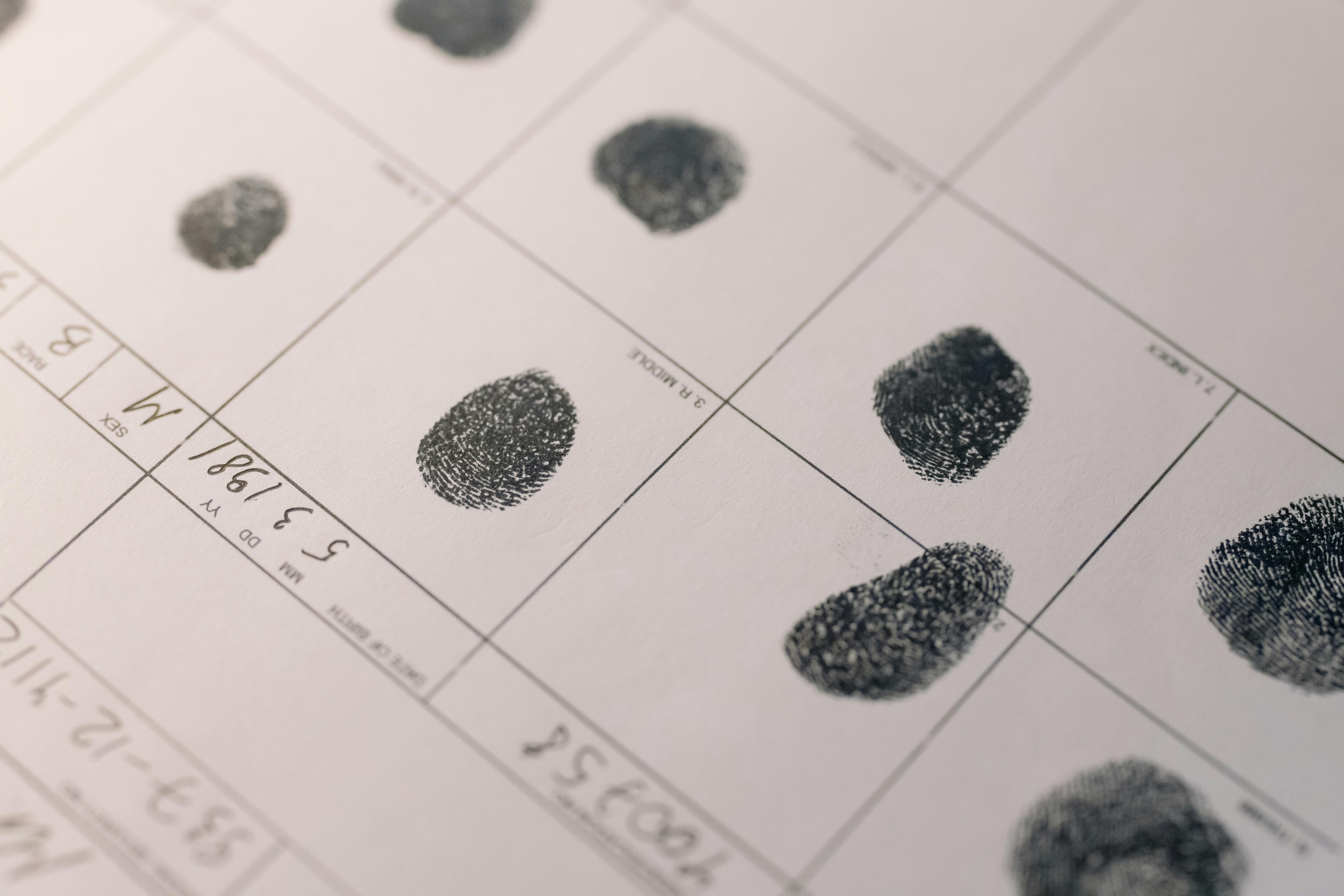
Ridge patterns form in the womb and stay put throughout life — present and unique from birth. Fingerprints are also the most widely supported biometric format in ABIS systems worldwide, including the infrastructure already running national civil ID programs. And unlike every other modality, fingerprint capture and matching for newborns has been validated in multiple peer-reviewed studies, including longitudinal clinical trials.
The modality is right. But the scanner still has to be.
Why standard fingerprint scanners still fail newborns
A newborn's fingerprint ridges are up to 2.5 times finer than an adult's. Standard scanners operating at 500 ppi — the resolution used in most national ID programs — cannot resolve that level of detail. The image comes out blurred or featureless.
Resolution is only half the problem. Most conventional scanners use a glass contact surface. When an infant's finger presses against that surface, the soft skin deforms on contact. Ridges merge with valleys. The fine detail the system needs to capture is destroyed before the scan even begins. No amount of added resolution fixes a problem that is mechanical, not optical.
This is why programs need a fundamentally different approach.
How Synolo® solves this
The Synolo® Neo captures fingerprints without ever touching the finger. The infant's finger is placed in a fixed aperture — no glass, no contact, no deformation. Purpose-built optics operating at 3,000+ ppi resolve the fine ridge detail of even the smallest newborn fingers.
Because there is no contact deformation and no AI reconstruction between the captured image and the stored template, the identity record represents the actual fingerprint. The processing pipeline normalizes infant ridge spacing and converts the output to formats compatible with standard national ABIS systems.
Clinical validation backs this up. A prospective trial published in Nature Scientific Reports followed 494 children from birth for up to 19 months, confirming reliable enrollment from the first days of life and long-term matching across the study period. Independent researchers at Clarkson University, with no commercial relationship to Synolo®, tested the system across 254 children from newborn to fifteen years. These studies span multiple countries, institutions, and populations.
Ready to build identity from birth?
If your program needs biometric identification that works from day one and scales across a lifetime, Synolo® has the technology and the clinical evidence to support it. Get in touch to learn how the Synolo® Neo can fit into your civil registration, healthcare, or child protection program.
Ready to innovate with infant biometrics?
Get in touch and discover how Synolo® Neo can transform civil identification.
Contact UsReferences
UNITED NATIONS. Sustainable Development Goal 16.9. Available at: https://indicators.report/targets/16-9/. Accessed: 2015.
WORLD BANK GROUP. Identification for Development (ID4D) Global Dataset. Washington: World Bank, 2018.
ENGELSMA, J. J.; DEB, D.; CAO, K. et al. Infant-ID: Fingerprints for Global Good. IEEE Transactions on Pattern Analysis and Machine Intelligence, v. 44, n. 7, p. 3543–3559, 2022. DOI: 10.1109/TPAMI.2021.3057634.
SAGGESE, S.; ZHAO, Y.; KALISKY, T. et al. Biometric recognition of newborns and infants by non-contact fingerprinting: lessons learned. Gates Open Research, v. 3, n. 1477, 2019. DOI: 10.12688/gatesopenres.12914.2.
JAIN, A. K.; ARORA, S. S.; CAO, K.; BEST-ROWDEN, L.; BHATNAGAR, A. Fingerprint Recognition of Young Children. IEEE Transactions on Information Forensics and Security, v. 12, n. 7, p. 1501–1514, 2017. DOI: 10.1109/TIFS.2016.2639346.
JAIN, A. K.; ROSS, A.; PRABHAKAR, S. An introduction to biometric recognition. IEEE Transactions on Circuits and Systems for Video Technology, v. 14, n. 1, p. 4–20, 2004.
CORBY, P. M. et al. Using biometrics for participant identification in a research study: a case report. Journal of the American Medical Informatics Association, v. 13, n. 2, p. 233–235, 2006.
BHARADWAJ, S.; BHATT, H. S.; SINGH, R.; VATSA, M.; SINGH, S. K. Face Recognition for Newborns: A Preliminary Study. In: IEEE INTERNATIONAL CONFERENCE ON BIOMETRICS: THEORY, APPLICATIONS AND SYSTEMS (BTAS), 2010, p. 1–6.
WEINGAERTNER, D.; BELLON, O. R. P.; SILVA, L.; CAT, M. N. L. Newborn's Biometric Identification: Can It Be Done? In: VISAPP, 2008, v. 1, p. 200–205.
KALISKY, T.; SAGGESE, S.; ZHAO, Y. et al. Biometric recognition of newborns and young children for vaccinations and health care: a non-randomized prospective clinical trial. Scientific Reports, v. 12, n. 22520, 2022. DOI: 10.1038/s41598-022-25986-6.
SUMI, M. R.; IMTIAZ, M. H.; SCHUCKERS, S. A Longitudinal Study on Fingerprint Recognition in Infants, Toddlers, and Children. Preprints.org, 2024. DOI: 10.20944/preprints202405.0224.v1.
HOSSAIN, A.; SUMI, R.; SCHUCKERS, S. Evaluating Deep Learning-Based Face Recognition for Infants and Toddlers: Impact of Age Across Developmental Stages. In: IEEE INTERNATIONAL JOINT CONFERENCE ON BIOMETRICS (IJCB), 2025, Osaka, Japan, p. 1–9. DOI: 10.1109/IJCB65343.2025.11410705.
SOUTHIER, L. F. P.; NUNES, G. A. T.; MACHADO, J. H. P. et al. A Systematic Literature Review on Neonatal Fingerprint Recognition. ACM Computing Surveys, v. 57, p. 1–34, 2025. DOI: 10.1145/3735551.
Topics
infant biometrics · newborn identification · newborn biometrics · infant identification · newborn fingerprinting · baby biometrics · baby identification · neonatal biometric registration · hospital newborn identification · maternity hospital newborn biometrics · newborn birth registration biometrics · civil identity · child protection infant biometrics · Synolo Neo · non-contact fingerprint scanner · baby fingerprint scanner · FBI PIV certified · 3000 PPI fingerprint scanner · ABIS integration · birth to adulthood infant biometric matching · longitudinal fingerprint matching · newborn face recognition · iris recognition newborns · newborn footprint identification · baby swap prevention · newborn vaccination tracking biometrics
